A few years ago I was teaching in a school district with an International Baccalaureate program. To be honest, I still don’t fully understand everything about the IB program, but one thing I learned about because of the program was “Theory of Knowledge”. I remember hearing about the TOK class, and it sounded absolutely fascinating to me. A whole class dedicated to examining how we know what we know. When I was thinking about what I might want to teach other than Spanish, that class always came to mind. I want to engage with students meaningfully, and challenge them to question what they think they know. At the time I first learned about theory of knowledge, I didn’t know how to go about getting the kind of teaching certification that would allow me to teach that kind of class.
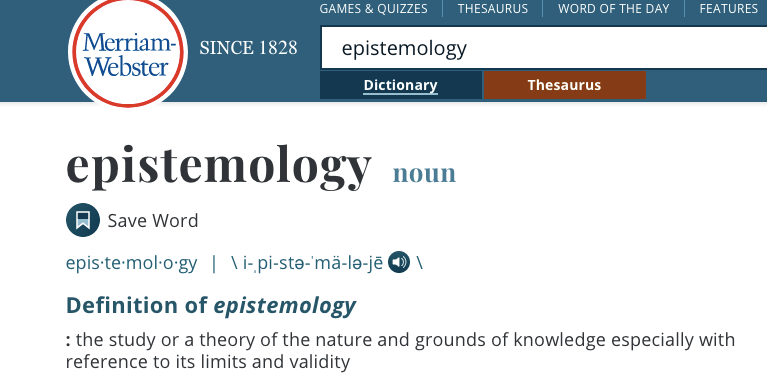
A few months ago, I started thinking about theory of knowledge again in the context of the huge divide in this country politically. I’ve been trying so hard to figure out how to talk to people with whom I disagree in a way that might prompt them to really look at what they’re saying with a critical eye, or to explain to me using reason and logic what they believe. So many people seem to just regurgitate things they hear others say without really considering the source, or doing real research. And it’s not just on one side. I’ve been guilty of it too from time to time–sharing information when I don’t quite know if it’s true, just because it fits what I want to believe. But for the most part, I try to only share information from reputable sources. Anyway, I started thinking about theory of knowledge before I had even applied for the job I have now, so it was certainly before I applied for the master’s program that I’m currently in. When I started looking into it, I discovered the word “epistemology”. According to Merriam Webster’s Dictionary:
And now I’m working on a master’s degree in Library an Information Science. I’m excited about the library part, don’t get me wrong, but the fact that I get to actually take classes on the science of information is just…super nerdy. And I’m pumped. Just a few weeks into the semester, epistemology was mentioned in the readings I had to do for one of my classes. I still don’t understand it fully, but I’m so excited to delve into it and learn more.
When I first signed up for a Facebook page (in about 2007), it was a fairly common thing to post quotes on your profile. One that I shared came from philosopher Bertrand Russell. It said, “The whole problem with the world is that fools and fanatics are always so certain of themselves, but wiser people are so full of doubts.“ I loved that quote when I first heard it, and I still think about it…I think about it a lot. I’m not saying I’m some wise sage, just that I realized a long time ago that there’s so much that I don’t know. And most of it, I’ll probably never learn. And, although it’s probably human nature to want to have all the answers, I’ve accepted that I don’t/won’t. But there are some things that I’m pretty confident about. For example, I know that a lot of the time people believe what they want to believe, even if all of the evidence supports the opposite. And fear probably has a lot to do with that. I’m not going to go into a lot of detail here, I just want to encourage anyone who reads this to think about what they believe to be true and why they believe it. As I learn more about the science of information, I may share more on the topic, but for now, I’ll leave you with another quote. This one is often attributed to Nicolaus Copernicus: “To know that we know what we know, and to know that we do not know what we do not know, that is true knowledge.“ Oof.
 growingmoxie.com