
I mentioned in my post last week that I’ve been working on a survey/tool to try to find some common ground between groups with wildly different viewpoints. I originally envisioned them being one thing that served two purposes, but the more I’ve thought about it, the more I think they need to be separate. Sadly, it’s taking longer than I thought it would to get them worked out. First, I’m working on a survey that I would like as many people as possible to take. Clearly pollsters have been way off lately, and I’m by no means expecting to have totally unbiased or comprehensive results. I just want to try to get a general idea of how people in this country think and what they value.
The second part of my project is a discussion tool. I think that, to get to the point that we have in society where pretty much every topic is potentially inflammatory, some of us have started to see each other as walking embodiments of politics instead of as human beings. We have to remember that none of us are perfect. And that, although someone may have very different ideas about what’s right than we do, that doesn’t mean they’re inherently bad people. Do I have a political identity? Yes. It doesn’t conform to a specific party, though I certainly lean pretty far in one direction. But I know some generous people who believe very differently than I do. I can’t reconcile it all in my head how they believe the way they do, but that isn’t what I’m trying to do. Well, maybe it is…I don’t know. Mainly I’m just so tired of hate and vitriol, and wondering when the other shoe is going to drop that launches us into an actual civil war. I feel like I need to do something about it and, even though I know that what I personally do may not make a huge impact, I hope that it can have little ripple effects.
So, here are the things I’ve been doing and/or plan to do:
1. For quite some time I have mostly avoided sharing divisive things on social media, and I plan to continue this. As much as I enjoy and agree with a lot of things I see on my friends’ social media pages, I just don’t feel that I can be an effective moderator of sorts if I post them myself. I’m not trying to shame anyone for what they share, but I do think it’s important that we all take a look at ourselves and how our behavior might serve to either dampen or stoke the flames. I also know a lot of people who have hidden, unfriended, or unfollowed people on social media whose posts they know they’ll disagree with and, while I understand to an extent why they’ve done that, I think it’s a very dangerous game. Personally, I feel like I need to know what people who believe differently than I are doing and saying. It keeps me from being in my own echo chamber, and gives me an idea of what I might need to watch out for.
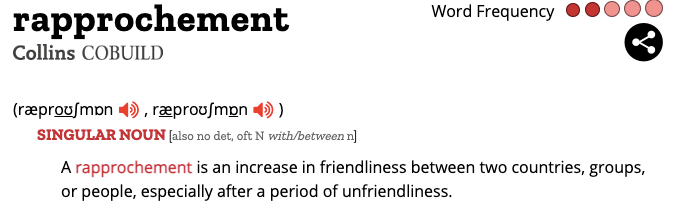
2. I have started, and will continue, learning about mediation, conciliation, and intercession strategies. And I will work on learning how to consistently spell and pronounce “rapprochement” correctly, because it most closely fits what I think the goal should be. 🙂 According to Collins Dictionary:
3. I will finish my two tools (survey and discussion aid), and work up the gumption to actually start having some hard conversations with people.
4. After some time and experience doing it on my own, I will make myself available as a mentor or intermediary of sorts to others who also want/need to have some difficult conversations. Disclaimer: I have no legal or psychological background other than taking a Psych 101 class in college. With that said, I think I’m often able to look at issues from multiple sides and also interpret what people are trying to communicate, even if their words don’t do a great job of conveying what they want to say.
There’s someone named Ryan Dowd whose work I follow pretty closely. He’s the director of a large homeless shelter near Chicago. He also does a lot of work with libraries, because he realized how important public libraries can be in the lives of people who lack housing security. I’m on his email list, and in his latest email newsletter he was talking about someone named Carl Wilkens, who is known as the only American who stayed in Rwanda during the genocide there in the 1990s. Wilkens has continued to work for years, trying to help heal the deep divide that led to the genocide. He wrote a book that chronicles his time in Rwanda called I’m Not Leaving.
In Ryan Dowd’s email this week, he likens the divide in the U.S. right now to the divide that eventually led to the genocide in Rwanda–it’s a terrifying concept. And it fit so perfectly with what I’ve already been thinking about I wanted to share something from it. Dowd’s emails usually advertise for his next webinar, but they also always include actionable information. In this email, he said:
“You can learn from the Rwandan experience.
1. Strategies for rebuilding community
2. Methods for healing deep divisions
For example, Rwanda had to balance the need for justice and the need to reconcile people.
• Rwanda couldn’t just “forgive and forget” murder. There had to be consequences for those who participated in genocide.
• At the same time, Rwanda couldn’t execute everyone who participated in the genocide. There were simply too many people.
Similarly, you can’t ignore racist/sexist/homophobic comments or name-calling between co-workers. At the same time, you can’t simply fire everyone who ever made an inappropriate comment.“
Clearly this particular email is addressing potential divides in the workplace, but I found that it so clearly articulated what I’ve been trying to figure out how to say, I had to share it. I feel like we still have a chance of restoring some civility here in the U.S., but we may not have a lot of time left before the scale is tipped too far. And, as satisfying as it can be to scoff at what “the other” is doing and discount what they’re saying, that does nothing to help us heal as a country from decades of increasing division between the two major political parties.
There’s a quote by Maya Angelou that is often shortened simply to, “Know better, do better”, but the actual quote, as recounted by Oprah Winfrey, is so much more meaningful: “I did then what I knew how to do. Now that I know better, I do better.” This quote in its full form requires us to take responsibility for ourselves. I’ll be the first to admit that I don’t always get things right, and I’m sure I’ve said and done things that have hurt others in some way. That’s not always an easy thing to own up to, but it’s absolutely true. And I think it’s imperative that we ALL take responsibility for the things we do and say. For us to be a society that’s whole, we might have to meet people where they are. If all we do is tell them they’re wrong, they’ll double down on their beliefs. I think it’s only by treating everyone with compassion and empathy, while still holding them accountable for their words and actions, that we’ll be able to start coming together so we can learn from each other how we can do better.
Again, I’m not saying we should let people off the hook who have done and said terrible things–they need to take responsibility for themselves. But we also can’t dismiss their humanity. In my experience, fear is a huge motivator for human behavior. When someone doesn’t understand something, or is uncomfortable with something, their fear of the unknown can prompt a lot of defensiveness and anger. Now, again, I’m not excusing bad behavior, I’m trying to understand it. In my opinion, there are a lot of people who got swept up in a movement where their fears were recognized and validated, maybe for the first time. That’s a powerful feeling–to be accepted for who you are and what you believe. Especially if you’ve been made to feel bad for it in the past. And, for many white people, when all they’ve ever known is privilege, it probably does feel like something is being taken away from them. This doesn’t make it right, and this certainly doesn’t mean I agree, I’m just trying to understand where they’re coming from. And what I’ve come to realize is that we HAVE TO move forward with compassion. We might need to acknowledge people’s feelings that we think are irrational in order to reach them and help them understand our points of view. It won’t be easy. But I don’t see another way to come back from this point of hostility without doing some difficult things. And I’m not alone.
After I thought I had this blog post almost totally finished, a friend shared an interview from NBC News titled, ‘This isn’t the final chapter’: Analyst warns, again, about rise of right-wing extremists on social media this week. It pretty much validates everything I’ve been trying to say. And, although I think everyone should read the whole article, I want to share this quote from Daryl Johnson, a former analyst at a branch of Homeland Security, because I think it’s SO IMPORTANT: “If you’ve got family members, neighbors, co-workers that are part of these movements, rather than ostracize and debate and criticize and isolate them, we need to love them, have compassion and bring them into the mainstream. The only way you’re going to get rid of hate is through love. Every person I’ve ever known about that’s been a white supremacist has left the movement through an act of compassion or love. They didn’t leave it because someone convinced them that their belief systems were wrong.“
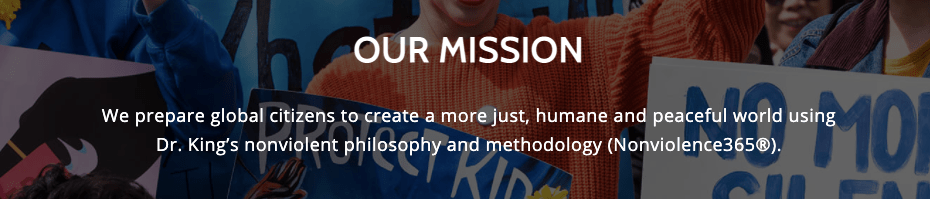
And THEN I got to thinking about Dr. Martin Luther King Jr. I got to hear Dr. King’s daughter speak once, a long time ago, when I attended a national church youth conference. I remember thinking how strange it was that I was listening to the daughter of such a prominent figure in the civil rights movement. In my sheltered little life in 1998, it seemed like racism was a distant memory–something my grandparents had seen, but far removed from me. I know now how naive I was–honestly, how naive I still am–to the everyday prejudices and microagressions that many people face. But the reason I wanted to add something about Dr. King to this post, other than the fact that the day that celebrates his life and achievements is this week, is that, when I was thinking back the other day to when I heard Dr. Bernice King speak, I googled her because I realized I didn’t actually know what she did for work. I found that she is CEO of The King Center, where she continues the work of her parents. The mission of The King Center is this:
What incredible work the King family has done, and continues to do. I encourage everyone to, at the very least, spend a little time looking at The King Center‘s website on this day that we remember Dr. Martin Luther King Jr. There are so many resources there, and I think we all could benefit from learning more. I want to end this post with a quote from Dr. King’s Nobel Peace Prize acceptance speech in 1964, because I think it’s so appropriate for the times we’re in now: “I believe that unarmed truth and unconditional love will have the final word in reality. This is why right temporarily defeated is stronger than evil triumphant.“
 growingmoxie.com