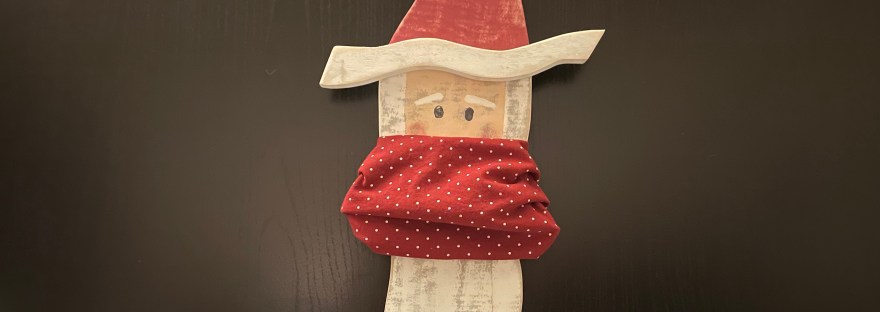
I’ve never had a ton of acne, but in my almost forty years of existence I’ve had my share of zits that I tried to cover up. They always seemed to come out of nowhere, with very little warning. I thought I’d mostly outgrown pimples…then I started wearing masks when I went to work, and suddenly I was often battling a blemish or two. And before you try to tell me that I need to wash my masks, I DO wash them–regularly. Maybe my face doesn’t agree with the laundry detergent I’m using?
Anyway, about maskne–I know it looks weird, but it makes sense if you say it out loud. It came to me a few months ago when I was dealing with yet another red spot on my chin after working, masked, several days in a row. I knew I probably wasn’t the only one to think up this word–I Googled it just now because I was curious and the first mention of it I saw was in this article in the New York Times in June, but I still felt a little bit clever for thinking of it. And it occurred to me the other day that maskne is kind of a good metaphor for figurative pimples caused by covering up parts of our inner selves too. When we try to hide our true selves, usually because we’re trying to keep ourselves “safe”, we sometimes develop internal blemishes–little pain points in our psyche about whatever it is that we’re covering up. Those little things we feel ashamed about can then become inflamed and often come out as defensiveness or anger. And if we’re always keeping those parts of ourselves hidden, and never allow our true selves to come out, those little infections can grow and fester, and make us (and sometimes those around us) miserable.
I’m not suggesting that we shouldn’t wear masks–I absolutely think we should all be wearing literal masks while in public right now. I also think there are certainly times in life that we may want to cover up parts of our inner selves to stay safe. When you start a new job and you don’t know anyone, for example, you may not want to share too much about yourself until you know you can trust your new coworkers. Or when you’re out in public, it’s probably not a great idea to say whatever pops into your head because you don’t know what the strangers around you might do if you say something that offends them. And when there’s a pandemic involving airborne virus particles, you should really wear a mask to protect those around you (and yourself, because studies are showing that mask wearing helps reduce risk of transmission going both ways). But it’s also important to show up how we can, and be vulnerable with (and for) each other, even when that may mean revealing parts of ourselves that we would prefer to keep hidden.
I think the key in any masking situation (literal or not) is to know when you’re safe to go maskless. We all need the ability to breathe freely and be our true selves sometimes. So I guess my wish for us all as this pandemic continues into the depths of winter, is that we find time and space to take our masks off. Let ourselves breathe, establish real connection with others (physically distanced though it may need to be for now), and if there are parts of ourselves that we really don’t like and don’t want others to see, maybe take this season to work through them and figure out if they’re really something we need to hide or if they’re something we just need to get over. Or if they’re maybe something we want to change about ourselves–we all have the ability to change certain things if we truly want to.
Whatever you do in your maskless time, remember that we’re all experiencing circumstances we’ve never endured before. We need to be kind to ourselves and each other, and work together to get through it, even though it can be scary to take our masks off and let ourselves be seen. Brené Brown, PhD, LMSW, has researched shame and vulnerability for decades, and has become something of a sage to me in the last couple of years. She posted this on Instagram on March 21st:
“This pandemic experience is a massive experiment in collective vulnerability. We can be our worst selves when we’re afraid, or our very best, bravest selves. In the context of fear and vulnerability, there is often very little in between because when we are uncertain and afraid our default is self-protection. We don’t have to be scary when we’re scared. Let’s choose awkward, brave, and kind. And let’s choose each other.”
 growingmoxie.com